For many commercial property owners, retirement brings an important question: how do you reduce the responsibilities of property ownership without triggering a significant capital gains tax bill?
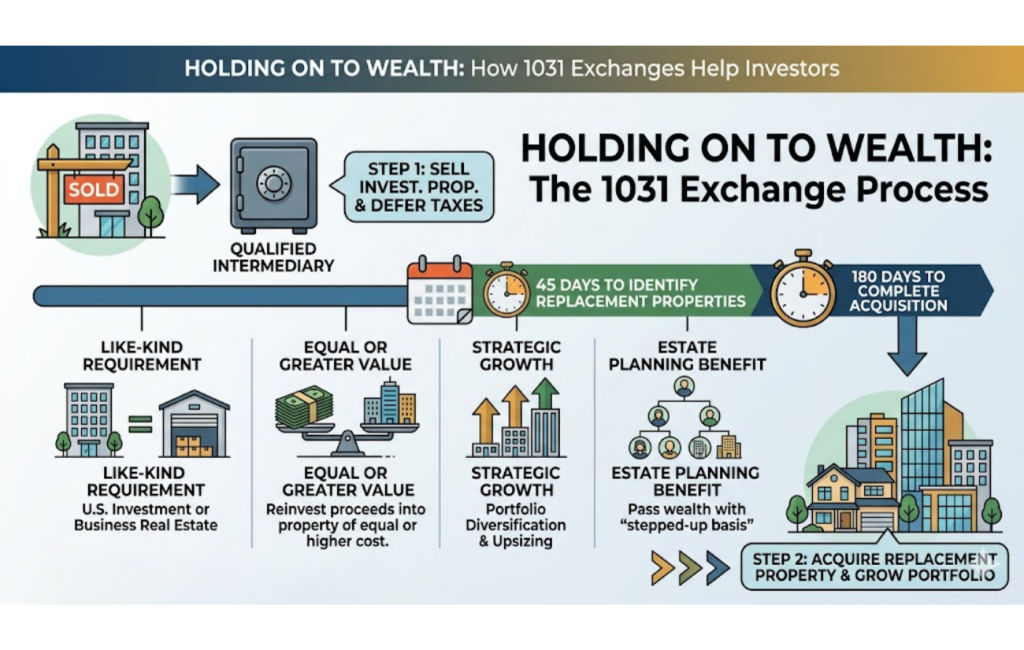
A 1031 exchange can provide a powerful solution. Named after Section 1031 of the Internal Revenue Code, a 1031 exchange allows investors to defer capital gains taxes by reinvesting proceeds from the sale of an investment property into another qualifying property. For retiring owners, this strategy can help preserve wealth, generate passive income, and simplify real estate holdings while avoiding an immediate tax burden.
Why a 1031 Exchange Matters in Retirement
Many long-term property owners have accumulated substantial equity over the years. Selling a commercial property outright can result in a significant tax liability, reducing the amount of capital available for future investments or retirement income.
A properly structured 1031 exchange allows owners to defer those taxes and reposition their investments into properties that better align with their retirement goals. Rather than actively managing tenants, maintenance issues, and day-to-day operations, owners can exchange into more passive investment structures while preserving the full value of their equity.
Popular 1031 Exchange Options for Retiring Owners
For a retiring owner who wants to step away from property management but defer taxes, there are several highly strategic exchange options.
Exchange into Passive Real Estate Through a Delaware Statutory Trust (DST)
A Delaware Statutory Trust (DST) allows an owner to pool their equity into a professionally managed portfolio of institutional-grade real estate, such as apartment communities, medical office buildings, industrial facilities, or other income-producing assets.
Because the properties are professionally managed, investors can receive passive income without directly dealing with tenants, maintenance, leasing, or property operations. For many retirees, this creates an opportunity to remain invested in real estate while significantly reducing management responsibilities.
Trade into Triple-Net (NNN) Leased Properties
Another common strategy is exchanging into a triple-net leased property occupied by a strong corporate tenant.
Under a triple-net lease structure, the tenant is generally responsible for property taxes, insurance, and maintenance expenses. As a result, the owner receives a more predictable income stream with fewer management obligations.
For retirees seeking dependable cash flow and simplified ownership, NNN properties can be an attractive alternative to more management-intensive commercial assets.
The “Swap Until You Drop” Estate Planning Strategy
A 1031 exchange can also play a role in long-term estate planning.
Many investors use a strategy commonly referred to as “swap until you drop,” where they continue exchanging properties throughout their lifetime rather than selling and recognizing taxable gains.
If the replacement property is held until death, heirs may receive the property with a stepped-up tax basis. In many cases, this can eliminate the deferred capital gains taxes entirely, allowing the next generation to inherit real estate assets with significant tax advantages.
Key 1031 Exchange Rules to Follow
While the benefits of a 1031 exchange can be substantial, the IRS imposes strict requirements that must be followed.
Use a Qualified Intermediary
The property owner cannot take direct possession of the sale proceeds. Instead, a Qualified Intermediary (QI) must hold the funds between the sale of the relinquished property and the purchase of the replacement property.
The 45-Day Identification Rule
Within 45 days of closing on the sale, the owner must formally identify potential replacement properties in writing.
The 180-Day Exchange Period
The replacement property must be acquired within 180 days of the sale of the original property.
Maintain Value and Equity
To achieve full tax deferral, the replacement property should be equal to or greater in value than the property being sold, and all net proceeds should be reinvested. Any cash retained by the seller may be considered “boot” and could become immediately taxable.
Planning Ahead Is Essential
A successful 1031 exchange requires advance planning, coordination among advisors, and strict adherence to IRS deadlines. Waiting until a property is under contract to begin exploring exchange options can significantly limit available opportunities.
Commercial property owners considering retirement should begin evaluating their objectives well before a sale occurs. Understanding available replacement property options and establishing a clear strategy can help maximize the benefits of the exchange.
Final Thoughts
A 1031 exchange is one of the most effective tools for preserving wealth in real estate. By deferring taxes and reinvesting full proceeds, investors can continue growing their portfolios while transitioning into ownership structures that better fit their retirement goals.
Whether you’re selling an office building, retail property, industrial facility, or investment portfolio, a 1031 exchange may provide a path toward greater flexibility, passive income, and long-term wealth preservation. With proper planning and professional guidance, it can be an important component of a successful retirement strategy.