
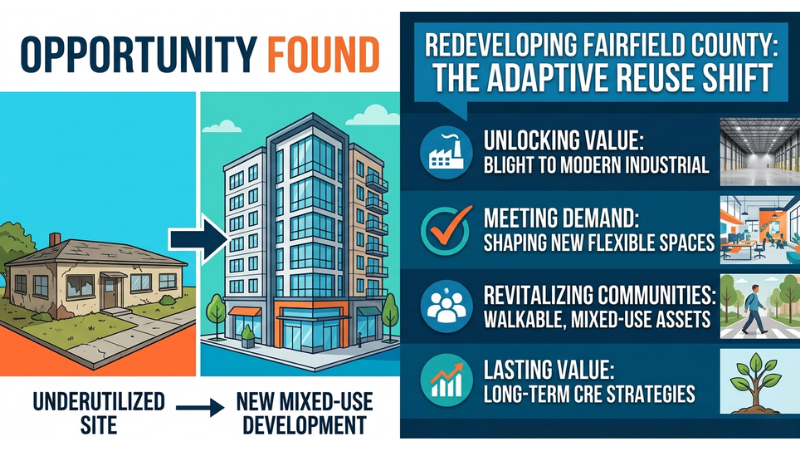
- Adaptive reuse is reshaping Fairfield County commercial real estate, as outdated office, retail, and single-use buildings are repositioned for modern demand.
- Developers like Joe Vaccaro and Darien-based V20 Group are unlocking value by transforming blighted and underutilized properties into industrial and mixed-use assets.
- Industrial and mixed-use redevelopment reflects shifting tenant demand, favoring flexible space, walkability, and community-oriented uses over legacy formats.
- For property owners and investors, long-term redevelopment strategies can outperform quick fixes, creating lasting value for both communities and the local CRE market.
Fairfield County redevelopment is reshaping the commercial real estate landscape across Darien, Stamford, and Norwalk. As aging office, industrial, and retail properties find new life through adaptive reuse and mixed-use development, communities are benefiting from projects that better align with modern market demands.
One local example frequently cited in redevelopment conversations is Darien-based V20 Group, led by Joe Vaccaro. Since launching the company in 2017 alongside his father, Jon Vaccaro, the firm has completed more than 20 projects across Fairfield County. Their work throughout Darien, Stamford, and Norwalk reflects many of the trends reshaping the region’s commercial real estate landscape.
Finding Opportunity in Overlooked Properties
A common thread across many successful redevelopment projects is a willingness to acquire properties that no longer function in their existing form. Aging office buildings, struggling retail centers, and obsolete commercial structures often require more than surface-level improvements to regain relevance.
V20 Group has focused much of its activity on these types of assets—properties others may have passed over—by identifying how zoning, location, and physical characteristics can support a more viable use. For property owners, this reinforces an important takeaway: marketability doesn’t always hinge on cosmetic upgrades. In many cases, unlocking value requires a fundamental shift in how a property is positioned.
Industrial and Warehouse Redevelopment Responds to Market Demand
One of the strongest shifts in Fairfield County commercial real estate has been the growing demand for industrial and warehouse space, particularly facilities with higher ceiling clearances and modern loading capabilities. In several cases, older office or industrial park properties have been redeveloped into high-bay warehouse facilities better suited for today’s logistics, storage, and service users.
For example, a formerly vacant office property within an industrial park on West Avenue in Stamford has been transformed into a 76,000-square-foot high-bay warehouse.
The firm is also active in Stamford on Hamilton Avenue, where it is constructing a warehouse on the former World Wrestling Entertainment studio site.
These projects reflect a broader reality: while traditional office demand has softened in certain segments, industrial and flex space remains highly competitive. Strategic redevelopment can help bridge that gap—preserving land value while aligning assets with where tenant demand is today.
Mixed-Use Development as a Revitalization Tool
Mixed-use projects have also become a cornerstone of redevelopment across the region. In Darien, the transformation of older shopping centers and underperforming commercial sites into developments that combine residential and retail uses illustrates how mixed-use can support both economic vitality and community needs.
Heights Crossing, located in the former Noroton Heights Shopping Center at 320–450 Heights Road, opened in the fall with 65 apartments and just under 30,000 square feet of retail space.
Nearby, the Heights Corner development will replace underused buildings on Heights Road with a three-story mixed-use project featuring office space and 20 apartments.
Together, these projects highlight how modern mixed-use environments can bring foot traffic, housing, and commercial activity into a cohesive, walkable setting.
For retail and service tenants, these environments often provide built-in demand; for municipalities, they offer revitalization without sprawl.
Repurposing Single-Use Commercial Buildings
Another notable trend across Fairfield County is the repurposing of former bank branches and single-use commercial buildings. As financial services continue shifting online, many of these properties no longer serve their original purpose.
Rather than leaving them vacant, developers are repositioning these assets for boutique retail, showrooms, food concepts, or experiential uses.
In Darien, V20 Group has also converted a former bank branch on Boston Post Road into a new commercial use.
These conversions demonstrate how well-located properties can evolve meaningfully as consumer behavior changes.
Why Fairfield County Redevelopment Requires a Community-Driven Approach
What ultimately separates successful redevelopment from speculative repositioning is a deep understanding of the local market. Projects throughout Darien, Stamford, and Norwalk demonstrate that redevelopment works best when it reflects the needs of the surrounding community—not just broader real estate trends.
The firm is also involved in redeveloping the long-vacant Fairway Market property on Canal Street in Stamford, a project expected to include a luxury gym (Club Studio) and a grocery store.
Spending time in the neighborhood, understanding traffic patterns, evaluating competing uses, and observing how residents interact with space all play a role in determining a project’s success.
A Long-Term View in Commercial Real Estate
Redeveloping underperforming assets is rarely a short-term endeavor. Entitlements, zoning approvals, design, and construction require patience and long-term vision. Developers willing to commit to that process tend to create more durable value—both financially and within the community.
For property owners, the takeaway is clear: even assets that feel stagnant may hold untapped potential. For tenants, redevelopment is expanding options in markets where high-quality space remains limited.
As commercial real estate brokers based in Norwalk and working throughout Fairfield County, we view these redevelopment efforts not just as individual success stories, but as indicators of where the regional market is headed—and how thoughtful reinvestment continues to reshape the landscape.
This story includes previous reporting by staff writers Robert Marchant and Tyler Federo and former staff writer Tanya Babbar.


