Your office lease renewal is an opportunity to assess whether your current office still meets your business needs. Should you stay or relocate when your lease expires? Before you tour buildings or evaluate a renewal proposal, take a closer look at the office you already occupy. Understanding what works, what needs improvement, and what remains uncertain gives your next lease decision a clearer direction.
For companies with leases expiring in 2027, that conversation should begin even if the preference is to stay. The same address may still be the right choice, but familiarity alone does not tell you whether the space, costs, and lease terms will serve your business through another lease term.
Choyce Peterson’s Renew or Relocate? worksheet provides five questions to guide that initial discussion. You can complete it before exploring the market, using what you know about your current office and your business plans.
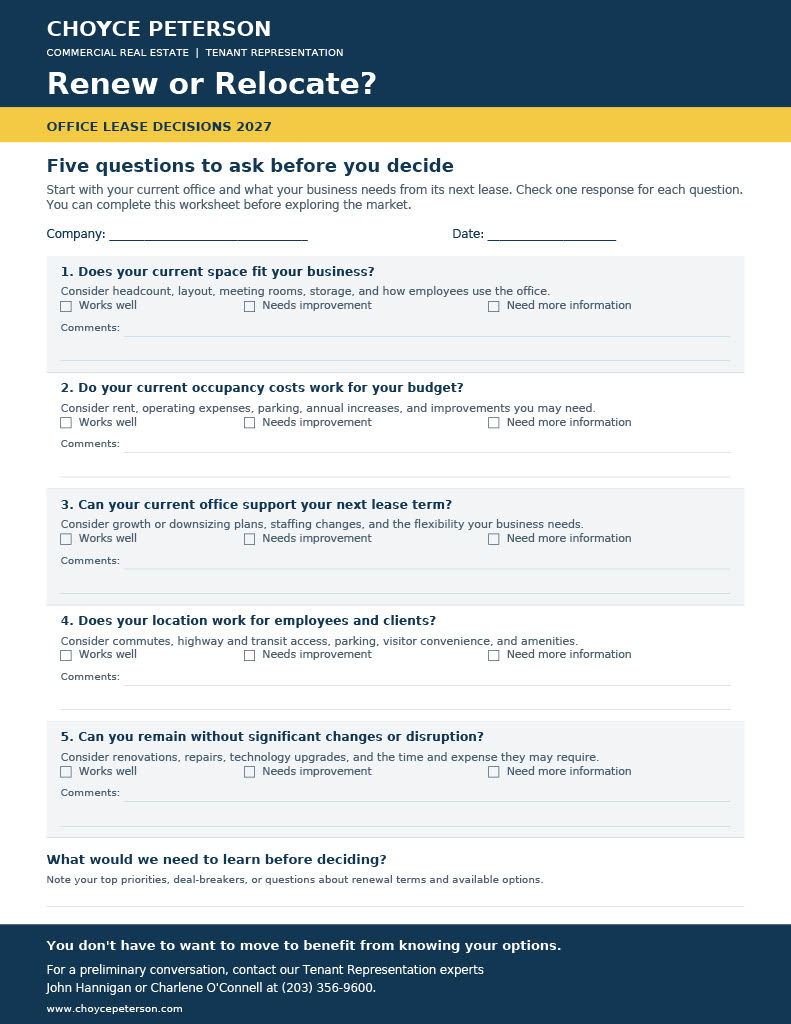
Download the Free Renew or Relocate? Worksheet
1. Does your current space fit your business?
Think about how your employees use the office today. Are meeting rooms consistently full while other areas sit empty? Do employees have the right balance of private work areas and collaborative space? Are you paying for space you rarely use, such as storage areas and rooms?
The issue may be the layout rather than the total square footage. For example, a company might have enough room overall but too few enclosed areas for calls and focused work. Identifying those needs now gives you a basis for considering improvements to your existing office (often which your landlord will pay for and provide) or evaluating another location.
2. Do your current occupancy costs work for your budget?
Start with the costs you already know: rent, operating expenses, parking, and scheduled increases. Consider improvements or upgrades your business may need as well.
Energy use also deserves a closer look. ENERGY STAR offers resources for office tenants on improving energy efficiency in leased space.
This first step is about understanding your current financial commitment and what your next lease needs to accomplish. Recognize that costs are becoming difficult to manage or that unused space deserves a closer look.
If you have not received renewal terms and proposals from competing landlords, mark that as information to obtain. Once renewal and relocation options are available, compare their full financial implications using consistent assumptions.
3. Can your current office support your next lease term?
A space that works today may be less suitable several years from now. Consider anticipated hiring, possible downsizing, expansion, changes in attendance, or new ways your teams may work together.
You do not need a perfect forecast. The goal is to identify foreseeable changes and the flexibility your business may need. Could the office accommodate another department? Would a smaller footprint make more sense? Are there lease provisions you would want to discuss before committing again?
These questions establish priorities for both the space and the next lease negotiation.
4. Does your location work for employees and clients?
Look beyond your own trip to the office. Consider employee commutes, highway and transit access, parking, visitor convenience, and nearby amenities.
For a Fairfield County business, the importance of each factor will vary. A company with frequent client visits may prioritize convenient visitor parking and easy access. Another may place greater emphasis on proximity to a train station or where employees live.
Whether your office is in Greenwich, Stamford, Norwalk, Westport, or a neighboring community, ask whether its location continues to support the people who use it.
5. Can you remain without significant changes or disruption?
Staying can feel like the easier choice, but it is still worth identifying what remaining would require. Does the office need renovations, repairs, technology upgrades, or a different layout? Could that work happen while employees continue using the space?
Document the changes you already know are needed, along with questions about cost, responsibility, and timing. You need to investigate those details before deciding.
If relocation becomes a possibility, moving expenses, construction, technology setup, and downtime will also need evaluation. For now, understanding the practical requirements of staying gives you a more realistic starting point.
How can the worksheet guide your office lease renewal decision?
For each question, choose Works well, Needs improvement, or Need more information. Then use the space at the bottom to record your top priorities, deal-breakers, and unanswered questions.
There is no total score or automatic recommendation to move. Several concerns may be addressed through a renewal negotiation or changes to the existing space. Other concerns may warrant exploring alternatives. The worksheet is designed to organize that conversation before you commit to a direction.
Frequently Asked Questions:
Can we use the worksheet before touring other offices?
Yes. It focuses on your current office and your business needs, so you can complete it before surveying the market. If you cannot answer a question, select “Need more information.” Those gaps can guide the next conversation with your leadership team and tenant representation broker.
What if we already expect to renew?
The worksheet is still useful. It can identify improvements, budget concerns, or flexibility you would like to address in a renewal. Understanding available alternatives can then provide context for evaluating the proposed terms. A preference to stay does not prevent you from making an informed comparison.
Does identifying problems mean we should move?
No. A layout concern, for example, might be resolved through renovations. Other issues may be harder to address in your current building. The next step is to determine which concerns can be resolved, what doing so would require, and how that compares with other available options.
Start with your priorities, then understand your options
You don’t have to want to move to benefit from knowing your options.
Download the worksheet and use it to begin an internal discussion. Choyce Peterson’s tenant representation team can then work with you to evaluate your requirements, explore available alternatives, and negotiate a renewal or relocation aligned with your business.
For a preliminary conversation about your 2027 office lease decision, contact John Hannigan or Charlene O’Connell at (203) 356-9600.