Commercial lease expiration planning should begin approximately 8–12 months before your lease ends if you have 8,000 sf or less, and 9-18 months if your space is larger. If your office lease expires in 2027, count backward from the actual expiration date to determine when your company should start.
A February expiration requires a different schedule from a December expiration. Renewal notice deadlines, construction requirements and internal approvals may also mean you need to begin earlier.
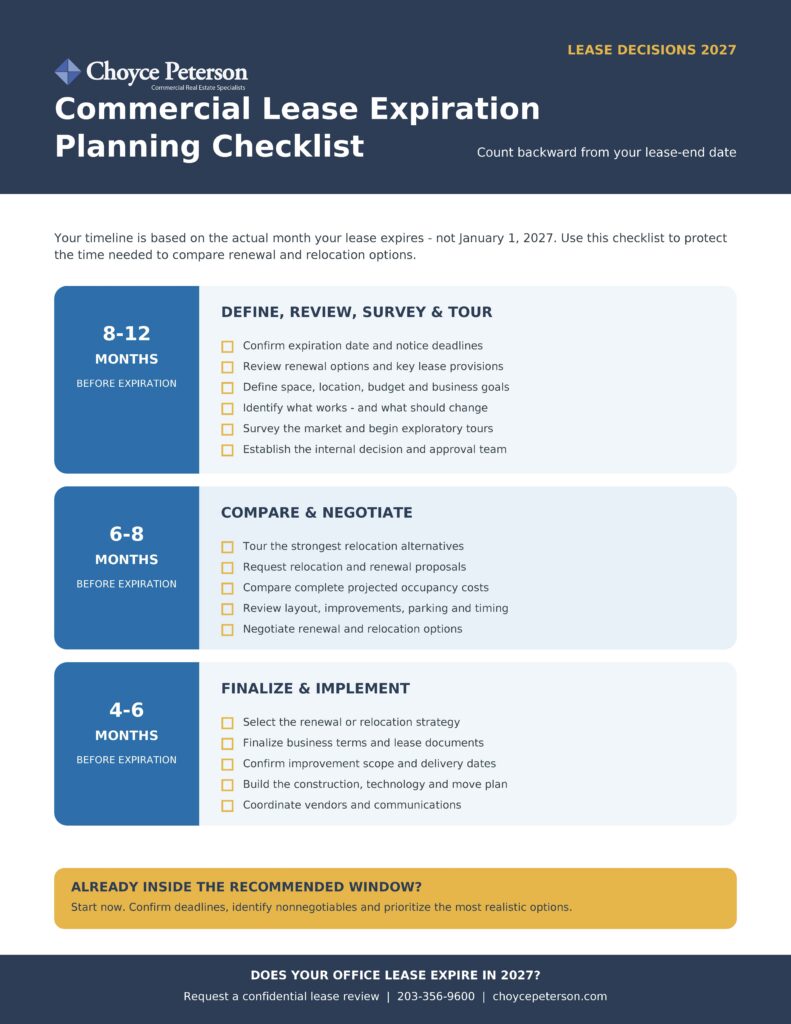
Our Lease Decisions 2027 checklist outlines three planning stages to help your company evaluate its options, negotiate terms and prepare for what comes next.
Why Start Commercial Lease Expiration Planning Early?
Your lease expiration is an opportunity to assess whether your office still supports your business. Has your headcount changed? Does the layout work? Are location, parking and building services meeting your needs?
Starting early gives leadership time to answer these questions and explore the market. Even if you prefer to renew, surveying and touring alternatives can provide useful context for evaluating your landlord’s proposal.
It also leaves time to address unexpected issues. A suitable space might require improvements, while a renewal could involve reconfiguring your current office. Both scenarios benefit from a clear schedule.
8–12 Months Before Expiration: Define, Review, Survey and Tour
Begin by confirming your lease expiration date, renewal options and notice deadlines. Review key lease provisions with your advisors so important requirements are incorporated into the planning schedule.
Next, define your company’s priorities. Consider space requirements, location, budget, employee access and anticipated business changes. The U.S. Small Business Administration’s guidance on choosing a business location highlights how location can affect rental rates, utilities and other business expenses. Use this planning stage to identify what works in your current office, what you would like to improve and how a renewal or relocation could support your goals.
Establish the internal decision and approval team. Knowing who will evaluate options, approve costs and authorize the final agreement helps keep the process moving.
With those priorities in place, survey the market and begin exploratory tours. Seeing available offices can help your team understand how different layouts, buildings and locations compare with your existing space.
Exploring alternatives does not commit you to moving. It gives you information to support a more informed renewal or relocation decision.
6–8 Months Before Expiration: Compare and Negotiate
During this stage, focus on the strongest relocation alternatives and request proposals for both a renewal and a potential move.
Compare complete projected occupancy costs rather than base rent alone. Depending on the proposal, those costs may include operating expenses, utilities, parking, improvements, furniture, technology and moving expenses. Consider concessions and the proposed lease term as well.
Evaluate how each option would function for your business. Can the layout accommodate your team? What improvements are necessary? Will the space be ready when you need it?
Negotiate renewal and relocation options while there is still time to evaluate them. Having realistic alternatives helps your company weigh the advantages, costs and practical requirements of each path.
4–6 Months Before Expiration: Finalize and Implement
Select your renewal or relocation strategy and work toward finalizing the business terms and lease documents.
Confirm the improvement scope, responsibilities and delivery dates. A signed lease is an important milestone, but implementation still requires coordination.
If you are relocating, build a schedule for construction, technology installation, furniture delivery and the move. Assign responsibilities to your internal team and vendors, and plan employee and client communications.
If you are renewing, determine whether improvements or changes to the existing office will affect daily operations. Scheduling that work carefully can help your team prepare.
These windows are planning guides. Extensive construction, complex requirements or earlier lease deadlines may call for a longer timeline.
Already Inside the Recommended Planning Window?
Start now. Confirm deadlines, identify your nonnegotiable requirements and prioritize the most realistic options.
An experienced tenant rep team like Choyce Peterson can help organize the process and identify which activities can move forward together. Waiting longer can leave less time to compare proposals and prepare for implementation.
Does Your Office Lease Expire in 2027?
We created our Commercial Lease Expiration Planning Checklist to give office tenants a practical starting point for organizing the renewal or relocation process. It brings the three planning stages outlined above into one easy-to-reference guide, helping your team see what to address and when.
Download the checklist, work backward from your lease expiration date and use it to guide internal discussions, assign responsibilities and track your next steps. Adjust the schedule to account for your renewal notice deadlines, approval process and any anticipated office improvements—even if your preference is to stay.
Contact John Hannigan or Charlene O’Connell at 203-356-9600 for a preliminary conversation.