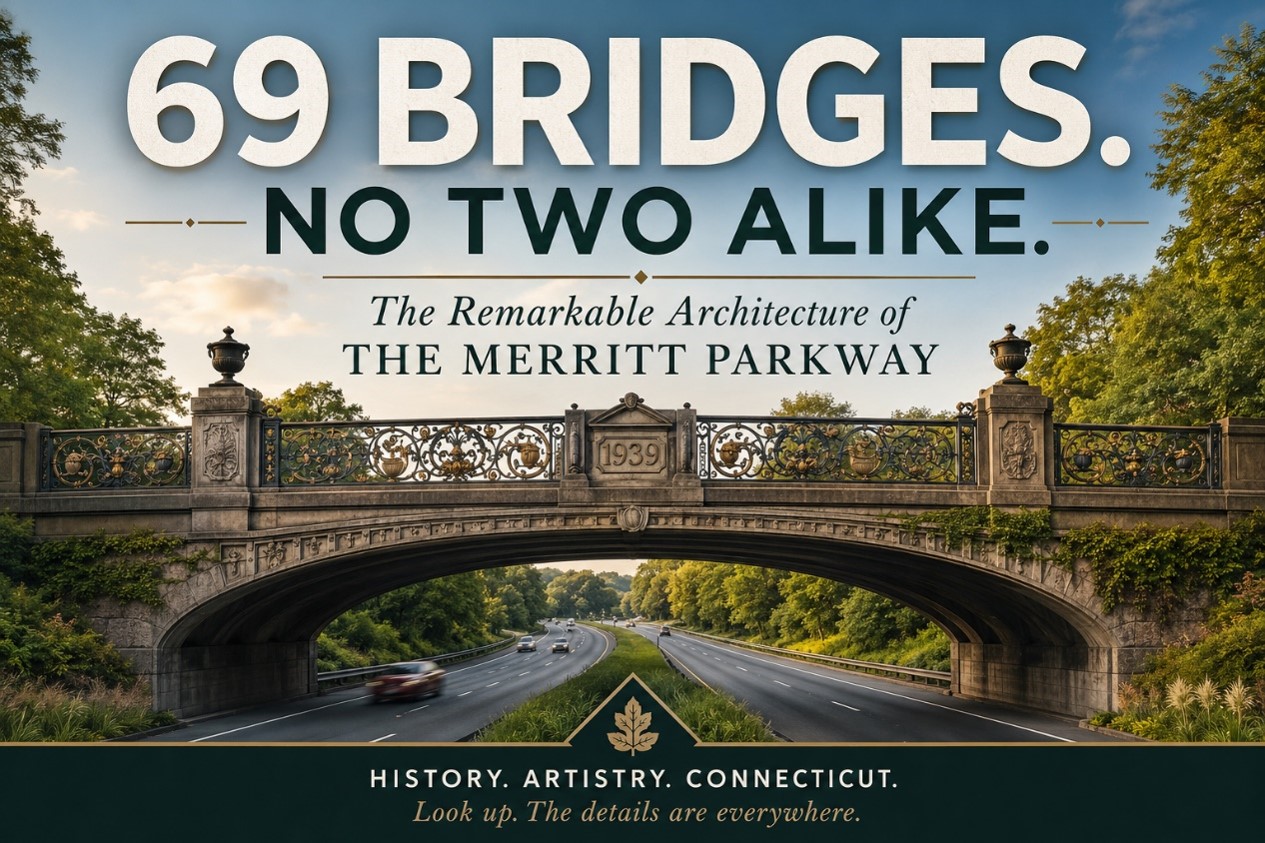
For generations of Fairfield County, CT residents, the Merritt Parkway bridges have been part of the familiar landscape of everyday life. We know the parkway’s winding curves, tree-lined medians and notoriously short entrance ramps, but it can be much easier to overlook the remarkable structures above us.
Stretching approximately 37.5 miles from Greenwich to Stratford, the Merritt Parkway is home to 69 historic bridges designed in an extraordinary variety of architectural styles. Rather than following a standard highway design, each bridge was individually conceived, incorporating influences ranging from Art Deco and Art Moderne to Gothic, Neoclassical and French Renaissance.
Look closely and you’ll find grapevines and urns, butterflies and spider webs, ferns and flowers, sculpted wings and elaborate stonework.
The Merritt Parkway isn’t simply a road through Fairfield County. In many ways, it’s a 37-mile-long outdoor gallery of architecture and design.
A Parkway Designed to Be an Experience
The Merritt Parkway was conceived in the early 20th century primarily as a way to relieve congestion on the Boston Post Road, or U.S. Route 1. Construction began during the Great Depression, with the first section opening in 1938 and the completed parkway opening in 1940.
But from the beginning, this was intended to be more than an efficient route from one place to another.
The roadway was carefully integrated into the rolling landscape of Fairfield County, following its natural terrain rather than cutting a straight path through it. Landscape architects worked to create the impression of traveling through a park, with vegetation and natural features helping the highway blend into its surroundings.
Even its bridges were designed with the driver’s experience in mind.
Architect George L. Dunkelberger, working for the Connecticut Highway Department, was responsible for the designs of the Merritt’s bridges. Instead of developing one economical design and repeating it dozens of times, Dunkelberger approached the structures individually.
The result is one of the defining features of the Merritt Parkway: no two bridges are exactly alike.
Architecture Hiding in Plain Sight
Most of the Merritt’s bridges were constructed of concrete, in part because it was less expensive than the masonry used on some other parkways of the era.
That limitation became an opportunity.
Concrete could be tinted, textured, carved and molded. Decorative metalwork, sculptures, reliefs and other architectural elements could be incorporated into the structures. Dunkelberger used those possibilities to give individual bridges their own identities.
Some are understated.
Others are anything but.
Lake Avenue: One of the Merritt’s Showpieces
Among the Parkway’s most elaborate bridges is the Lake Avenue Bridge in Greenwich.
Its decorative metalwork includes cast-iron grapevines, scrolls, urns and other ornamental details. Kenneth Lynch, whose company produced architectural metalwork for such landmarks as New York City’s Chrysler Building and Rockefeller Center, produced the metalwork used on the Merritt Parkway bridges.
The Lake Avenue Bridge also demonstrates how easily original design details can disappear over time.
Its ironwork was painted different colors during later decades, including green and blue. During its recent restoration, historical paint analysis helped identify the bridge’s original color scheme so its decorative features could once again more closely resemble their 1940 appearance.
The completed restoration received recognition from both the National Scenic Byway Foundation and Preservation Connecticut.
Yet Lake Avenue represents only one approach to bridge design along the Merritt.
Travel a little farther east and the details change completely.
From French Fortifications to Ferns in Westport
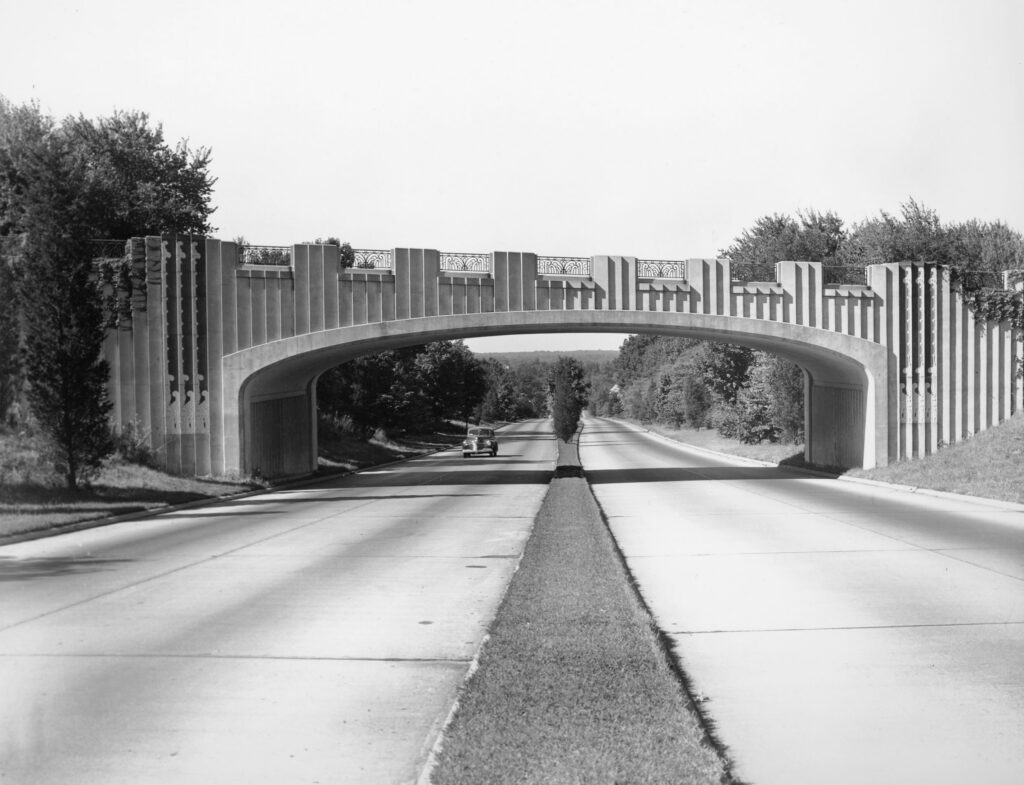
Two Westport bridges illustrate just how dramatically Dunkelberger’s designs could vary within only a few miles.
The 1939 Newtown Turnpike Bridge reflects French Renaissance Revival influences. Its rounded arches and concrete treated to resemble irregular stone masonry give it an appearance more reminiscent of an old fortified European structure than a highway overpass.
The nearby North Avenue Bridge, also constructed in 1939, takes an entirely different approach.
Here, Art Deco influences meet nature.
Decorative panels incorporate fiddlehead ferns, flowers and even a snail. Two-toned sgraffito — a decorative technique created by revealing contrasting layers beneath a surface — adds texture and color to the bridge.
Even the material used to achieve the effect was distinctive: aggregate included Wisconsin black onyx and Swedish emerald pearl.
It’s the kind of detail that would be easy to miss at 50 miles per hour.
But that was part of the remarkable thinking behind the Merritt. The structures didn’t need to be studied up close to contribute to the experience. Their shapes, textures and silhouettes became part of the scenery.
Butterflies, Spiders and a Very Unusual Bridge in Fairfield
If there is one bridge that demonstrates how playful the Merritt’s designers could be, the Merwins Lane Bridge in Fairfield may be it.
Completed in 1940, the Art Deco bridge features concrete cast in horizontal layers, creating an unusual overlapping appearance.
Then there are the decorations.
Large sculpted concrete butterflies sit on the abutments. The metal railing panels depict spider webs, complete with cast spiders — and the spider appears in a different position within each panel.
Butterflies and spiders aren’t exactly standard highway infrastructure.
That’s precisely the point.
Details such as these transform otherwise functional pieces of engineering into something closer to public art.
A Monument to the Highway Department in Stratford
Near the eastern end of the Merritt, the James Farm Road Bridge in Stratford offers yet another interpretation.
Built in 1940 in a Moderne or Modern Classicism style, the double-span bridge has concrete surfaces designed to resemble rusticated masonry. Monumental center pillars support dramatic sculptural clusters composed of bird wings.
The wings were created by sculptor Edward Ferrari, whose work can also be found elsewhere along the Merritt.
The bridge even contains a subtle signature of sorts: cartouches on its abutments display the letters “CHD” for the Connecticut Highway Department.
The Merritt Parkway Conservancy describes James Farm Road as a “celebration” of the department responsible for creating the roadway.
There Are Details Everywhere
These four bridges represent only a fraction of what can be found along the Parkway.
The Comstock Hill Avenue Bridge in Norwalk is famous for its sculptural bas-reliefs depicting a Native American and a colonist. The Clinton Avenue Bridge in Westport features a pinkish finish intended to resemble Connecticut’s Stony Creek granite. Other bridges incorporate Gothic, Rustic, Neoclassical, Art Moderne and additional architectural influences.
Even color was part of the design vocabulary.
Concrete could be tinted or mixed with materials that produced subtle variations and shimmering effects. At James Farm Road, for example, white quartz incorporated into the concrete helped create its distinctive appearance.
Elements that today might seem unusually decorative for highway infrastructure were integral to the Merritt’s original design.
Preserving a Work of Art That Still Has a Job to Do
Preserving the bridges presents a challenge that restoring a traditional historic building does not.
The Merritt Parkway isn’t a museum.
It remains one of southwestern Connecticut’s major transportation corridors, carrying thousands of vehicles every day. Its bridges are working pieces of infrastructure exposed to weather, water, road salt, vehicle impacts and more than eight decades of use.
Structural safety has to come first.
At the same time, rehabilitation can threaten the very details that make these structures historically important. Replacing deteriorated concrete or metalwork isn’t simply a matter of finding a modern equivalent when the color, texture, shape and ornamentation are all part of the original design.
The Merritt Parkway Conservancy works with the Connecticut Department of Transportation to help preserve those aesthetic elements during bridge rehabilitation projects. That can involve historical research, paint analysis, restoration of decorative metalwork, matching original concrete treatments and protecting sculptural features.
The objective isn’t to freeze the Parkway in 1940. It’s to allow an active transportation corridor to evolve without losing the character that made it extraordinary in the first place.
More Than 85 Years Later, the Merritt Is Still Different
The Merritt Parkway was added to the National Register of Historic Places in 1991 and designated a National Scenic Byway in 1996. Those distinctions recognize something Fairfield County drivers may sometimes take for granted.
This isn’t an ordinary highway.
Its landscape, winding alignment and remarkable collection of bridges represent an era when transportation infrastructure could also be architecture, landscape design and public art.
Perhaps the most remarkable thing about the Merritt’s bridges isn’t simply that there are 69 of them, or even that they’re all different.
It’s the amount of thought devoted to details many travelers would see for only a few seconds.
A butterfly perched on a bridge in Fairfield. A snail hidden among decorative foliage in Westport. Cast-iron grapevines framing an overpass in Greenwich. Sculpted wings rising from concrete in Stratford.
They’ve been there for more than eight decades.
The next time traffic on the Merritt gives you an unexpected opportunity to slow down, take a look at the bridge ahead.
You may discover you’ve been driving past a work of art all along.
Note: Some background information in this article was reported by The Stamford Advocate.