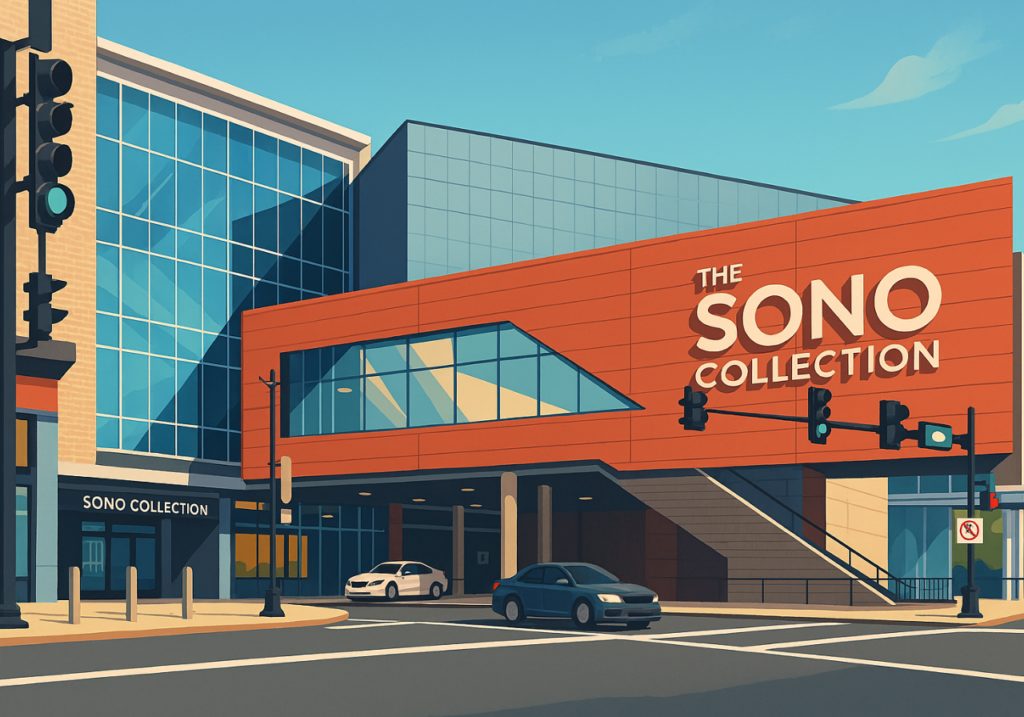
The SoNo Collection sale has captured the attention of investors, developers, and commercial real estate professionals across Connecticut. Just seven years after opening, the 738,000-square-foot retail destination in South Norwalk is being marketed for sale, prompting broader discussions about the future of retail real estate and the evolving role of shopping centers.
From a commercial real estate perspective, however, this move is less about distress and more about timing, strategy, and the continued repositioning of retail assets in a rapidly changing market.
A Strong Asset Enters the Market
Located along Interstate 95 in South Norwalk, The SoNo Collection benefits from exceptional visibility and access—two factors that remain critical in retail site selection. The property sits within one of the most affluent trade areas in the Northeast, serving a population of roughly 385,000 residents within a 10-mile radius, with average household incomes exceeding $235,000.
Anchored by high-performing retailers such as Nordstrom and Bloomingdale’s, and complemented by a curated mix of experiential and digitally native brands—including Apple, Sephora, and Warby Parker—the mall has maintained an occupancy rate of approximately 86%. In today’s retail environment, that figure signals relative stability, particularly when compared to older Class B and C malls struggling with vacancy and declining foot traffic.
Rather than indicating distress, the sale reflects what many in the industry recognize as a strategic disposition.
Connecticut’s Retail Landscape in Transition
The SoNo Collection’s listing comes amid a broader reshuffling of retail real estate across Connecticut. Several malls throughout the state are facing significant challenges, including declining tenancy, loan defaults, and, in some cases, full-scale redevelopment.
Properties such as the Crystal Mall in Waterford are being repurposed entirely, while others—including malls in Enfield, Waterbury, and Meriden—are exploring mixed-use transformations that incorporate residential, hospitality, and office components.
This divergence highlights a widening gap between high-performing, well-located retail centers and those that lack the demographics, access, or tenant mix needed to compete in today’s environment.
The SoNo Collection clearly falls into the former category.
Why Now? A Seller’s Market for Premium Assets
The decision to bring The SoNo Collection to market appears to align with a broader trend: owners of institutional-quality retail assets capitalizing on favorable market conditions.
“From an investment standpoint, this is less about concern and more about opportunity,” said John Hannigan, Principal at Choyce Peterson. “The SoNo Collection represents a high-quality, well-located asset in a strong demographic corridor. Bringing it to market now allows ownership to take advantage of investor demand for stabilized retail properties, while giving a new buyer the opportunity to unlock additional value through leasing and experiential repositioning.”
In other words, the current ownership group may be seeking to realize gains at a time when investor appetite for well-performing retail—particularly in affluent suburban markets—remains strong.
The Evolution of the Modern Mall
The potential sale also underscores a broader shift in how malls are being viewed and operated. Traditional retail alone is no longer sufficient to drive long-term success. Today’s most resilient centers are those that blend shopping with dining, entertainment, and community-driven experiences.
The SoNo Collection already reflects elements of this evolution, but future ownership could further enhance its positioning through:
- Experiential retail concepts
- Food and beverage expansion
- Entertainment and lifestyle offerings
- Strategic re-merchandising of vacant space
With approximately 110,000 square feet of vacancy, the property presents a clear opportunity for value creation—particularly for buyers with a vision for adaptive reuse or mixed-use integration.
What the SoNo Collection Sale Means for Retail Real Estate Investors
For commercial real estate professionals, the sale of The SoNo Collection is not an isolated event—it’s part of a larger narrative about the recalibration of retail.
Well-located, high-income trade areas like Fairfield County continue to attract capital, while underperforming assets face increasing pressure to reinvent themselves or transition to alternative uses.
At the same time, the distinction between “retail” and “mixed-use” is becoming increasingly blurred. Investors are no longer just buying shopping centers—they are acquiring platforms for experiential, community-oriented destinations.
What Comes Next
While the identity of a future buyer remains to be seen, industry expectations suggest a broad pool of potential investors—from institutional funds to private equity groups and mixed-use developers.
Given the property’s fundamentals, any new ownership group is likely to build upon its existing strengths rather than pursue a wholesale transformation. That said, incremental changes—particularly those focused on enhancing the customer experience—could further solidify The SoNo Collection’s position as a premier retail destination in the region.
For the City of Norwalk and the broader Fairfield County market, the sale is expected to function largely as a routine transaction, with minimal impact on day-to-day operations. Still, it will be closely watched as an indicator of investor sentiment and the future direction of retail real estate in Connecticut.
Final Thoughts
The listing of The SoNo Collection highlights both the challenges and opportunities facing retail real estate today. While some properties struggle to adapt, others—like SoNo—continue to demonstrate resilience, relevance, and long-term potential.
For investors and stakeholders, the message is clear: in the right location, with the right tenant mix and strategic vision, retail is far from obsolete. In fact, it may be entering its next—and more dynamic—phase.
Note: Some background information in this article was reported in the Westfair Business Journal.
To learn more about commercial real estate trends, office availability, and investment opportunities throughout Norwalk, explore our Norwalk Commercial Real Estate page.